Casters for Pharmaceutical Manufacturing: Contamination Control and cGMP Compliance on the Cleanroom Floor
In pharmaceutical manufacturing, the margin for error is measured in microns. A single particle shed from a piece of mobile equipment can compromise an entire batch of active pharmaceutical ingredient (API) or sterile injectable, triggering costly recalls and regulatory action. Within this tightly controlled ecosystem, casters—the mobility interface between process carts, laminar flow workbenches, and stainless steel trolleys—play a disproportionately important role. They must glide silently across ISO-classified floors, withstand aggressive chemical sanitization, generate zero particulate, and never become a harbor for microbial growth. For more than twenty years, China Hsinbon Caster Manufacturing Co., Ltd. has engineered casters purpose-built for the pharmaceutical sector, where contamination control and cleanability are designed in from the first drawing. Under the brand Hsinbon, the company supplies GMP-conscious manufacturers around the world with mobility solutions that meet the exacting standards of modern drug production.
The Cleanroom Caster: More Than a Wheel
Pharmaceutical facilities operate under cGMP (current Good Manufacturing Practice) guidelines enforced by agencies such as the FDA, EMA, and NMPA. Cleanrooms are classified per ISO 14644-1—from ISO Class 8 (less critical secondary areas) down to ISO Class 5 or tighter (aseptic filling suites). In these environments, a standard industrial caster is a liability. Zinc-plated frames corrode under daily VHP (vaporized hydrogen peroxide) fogging; unsealed ball bearings fling grease and collect grit; threaded kingpins and bolted joints create crevices where biofilm can establish.
Hsinbon addresses these risks with a purpose-designed cleanroom caster platform. The frame is investment-cast or precision-pressed from AISI 304 or 316L stainless steel, with all seams either fully welded or radiused and polished to a sanitary finish (Ra ≤ 0.8 μm on visible surfaces). There are no exposed threads on the yoke, no open cavities in the top plate, and no bolted-on decorative caps. The swivel raceway is sealed with a stainless steel or FDA-acceptable polymer cover, keeping lubricant in and washdown chemistry out. This "no-hide" geometry is fundamental to maintaining cleanroom integrity and passing routine environmental monitoring swabs.
Material Science: Non-Shedding Wheels and Chemical-Resistant Polymers
The wheel itself must not abrade or flake under load, as particulate generation is a primary concern in ISO Class 7 and cleaner zones. Hsinbon specifies solid-cast polyurethane or polyolefin treads formulated without plasticizers that could migrate or outgas. The polyurethane compound—typically 90–95 Shore A—is poured onto a stainless steel or nylon core and post-cured to eliminate surface tack. This produces a non-marking, low-particulate wheel that rolls quietly on vinyl, epoxy, or raised-access cleanroom flooring without scuffing or leaving residue.
For areas subjected to frequent exposure to IPA (isopropyl alcohol), hydrogen peroxide vapor, peracetic acid, and quaternary ammonium disinfectants, Hsinbon validates wheel and seal compounds for swelling, hardening, or surface crazing after prolonged chemical contact. In high-hygiene zones where carts are steam-cleaned or undergo SIP (steam-in-place) protocols, high-temperature resistant TPU or glass-filled nylon wheels are offered, paired with high-temp bearing grease that will not separate under cyclic heating.
Bearings are a critical contamination vector. Hsinbon cleanroom casters use precision sealed stainless steel ball bearings—lubricated for life with pharmaceutical-grade grease—or Delrin® bushings in the most washdown-intensive applications. The seal design prevents ingress of cleaning fluids while containing internal lubricant, so nothing is deposited on the floor or into the airstream.
ESD Control in API and Solvent Handling Areas
Active pharmaceutical ingredient production often involves flammable solvents where electrostatic discharge presents a fire or explosion hazard. Additionally, sensitive electronic balances and analytical instruments in QC labs require static dissipation to prevent measurement drift. Hsinbon offers ESD-capable caster configurations for pharmaceutical environments: static-dissipative polyurethane treads (surface resistivity 10⁶–10⁹ Ω) bonded to a conductive stainless or aluminum core, with a continuous metal-to-metal path from axle to mounting plate. This ensures the cart is safely grounded through the ESD flooring system, neutralizing charge buildup as the operator pushes the trolley. The ESD version retains the same sealed stainless architecture and cleanability as the standard cleanroom line, so static control never comes at the expense of hygiene.
Braking, Maneuverability, and Ergonomics in Narrow Aisles
Pharmaceutical suites are rarely spacious. Mobile laminar flow hoods, WFI (water-for-injection) totes, and dispensing carts must be positioned precisely within confined cleanroom bays. Hsinbon incorporates tapered roller or double-ball swivel bearings to minimize initial push force—reducing operator fatigue during repetitive transfers between gowning rooms, buffer zones, and processing areas.
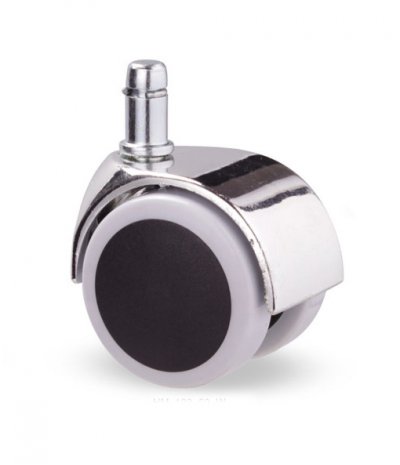
Braking systems are specified according to application. A total-lock brake (simultaneously locking both wheel rotation and swivel action with one pedal press) is standard for weighing balances and filling equipment that must stay absolutely stationary during operation. Directional locks—which fix the caster in the fore-aft axis—assist when long, narrow carts must be guided down tight corridors without lateral drift. All brake pedals are shaped for operation with cleanroom shoe covers and are accessible from both sides of the caster, with no undercuts that trap spray during disinfection.
Real-World Deployments: From Pilot Plant to Commercial Fill-Finish
The suitability of Hsinbon pharmaceutical casters is proven in diverse GMP settings:
Aseptic Filling Suites (ISO Class 7 / Grade C & B): Stainless steel component trolleys carrying sterilized stoppers and seals ride on Hsinbon 304 SS casters with white non-shedding PU wheels, surviving daily VHP decontamination cycles without discoloration or seal failure.
API Pilot Plants: Solvent-handling carts in Grade D zones use Hsinbon ESD-casters with static-dissipative treads and 316L stainless frames, resistant to splashes of acetone, methanol, and dichloromethane.
WFI & Buffer Preparation: Carts transporting glass carboys of purified water or buffer solutions are fitted with shock-absorbing Hsinbon casters that dampen vibration—protecting sensitive inline filters from pressure spikes caused by jarring impacts over floor thresholds.
Cold Chain / Refrigerated Sampling: In 2–8 °C sample storage rooms, low-temperature-formulated PU wheels maintain elasticity and roll freely where standard rubber would harden and skid.
One quality assurance manager at a multi-national vaccine producer commented after a retrofit project: "We replaced mixed-brand casters on our Grade C trolleys with Hsinbon stainless cleanroom series. Besides eliminating the rust spots we'd see after each sanitization cycle, our quarterly particulate counts attributable to cart movement dropped to undetectable levels."
Customization and Documentation for Validation Files
Pharmaceutical buyers require more than a product—they require traceability. China Hsinbon Caster Manufacturing Co., Ltd. supports validation efforts with full material declarations: stainless steel mill certificates (EN 10204 3.1), polymer data sheets confirming absence of prohibited substances (phthalates, heavy metals, latex), and dimensional inspection reports. Custom requests—such as a specific offset for a proprietary trolley frame, expanded-stem mounts for tubular stainless handles, or color-coded wheels for area segregation—are handled in-house thanks to the company's vertically integrated tooling, machining, and polyurethane casting capabilities.
For OEMs building cleanroom equipment (laminar flow cabinets, isolators, sterility test stations), Hsinbon engineers collaborate during the design phase to match caster dynamic load ratings, swivel radius, and overall height to the equipment envelope, ensuring the final assembly passes ergonomic push-force testing and cleanroom commissioning.
Sustainability and Lifecycle Value
Modern pharma campuses increasingly track Scope 3 emissions and specify equipment with demonstrable longevity. Hsinbon stainless steel caster bodies are fully recyclable, and the modular design allows wheel or bearing replacement without discarding the frame—extending service life and reducing waste. Durable polyurethane formulations mean fewer change-outs, lowering the total cost of ownership while reducing consumable waste sent to landfill.
Conclusion: Small Component, Significant Responsibility
In pharmaceutical manufacturing, compliance is built on fundamentals—air changes, HEPA filtration, gowning discipline, and the quiet competence of every piece of equipment that crosses the threshold. Casters may seem incidental until one sheds debris onto a Grade A fill zone or seizes mid-transfer, forcing a protocol deviation. China Hsinbon Caster Manufacturing Co., Ltd. understands that in the cleanroom, "good enough" is never good enough. Under the Hsinbon name, they engineer casters that protect product integrity, simplify sanitization, and move with the precision the industry demands. For pharmaceutical manufacturers committed to cGMP and operational excellence, that level of specialization isn't a luxury—it's an essential part of the quality system, rolling silently on four wheels, one batch at a time.