Casters for Woodworking Machinery: Heavy-Duty Mobility in Sawdust and Shavings
Walk into any woodworking shop—whether a small cabinetmaker’s garage or a 100-employee furniture factory—and you’ll notice the same challenge: stationary machinery dominates the floor. Table saws, planers, jointers, bandsaws, and sanders are heavy, vibration-prone, and difficult to reposition. Yet modern shops thrive on flexibility. A production run of kitchen cabinets may require the table saw in one corner today and against the dust-collection duct tomorrow. Large panel saws must roll out of the way to make room for a forklift delivering lumber. Mobile workbenches shuttle between stations. In all these scenarios, casters are the enablers of layout agility. For more than twenty years, China Hsinbon Caster Manufacturing Co., Ltd. has engineered casters specifically for woodworking environments, where fine dust, heavy loads, and constant vibration define daily reality. Under the brand Hsinbon, the company delivers mobility solutions that keep machines moving safely and accurately, even in the grittiest shop conditions.
The Woodshop Environment: A Test for Any Caster
Woodworking shops are uniquely hostile to standard industrial casters. Sawdust is fine, abrasive, and pervasive—it infiltrates unsealed bearings, packs into crevices, and combines with resinous sap to form a paste that can seize a wheel overnight. Chips and offcut scraps litter the floor, creating tripping hazards and irregular surfaces. Floors themselves vary widely: smooth concrete in new factories, old cracked slabs in heritage workshops, epoxy-coated surfaces in finishing rooms, and occasionally wooden subfloors in home shops.
Machines add complexity. A 10-inch cabinet table saw weighs 300–400 pounds. A wide-belt sander or industrial planer can exceed 1,000 pounds. When these machines operate, they generate intense vibration that works loose bolts, fatigues thin metal, and destroys poorly secured bearings. A caster that cannot handle these combined stresses will fail catastrophically—either collapsing under load or locking up mid-move, potentially damaging the machine or injuring the operator.
Hsinbon addresses these challenges with purpose-built woodworking machinery casters. Instead of adapting generic industrial designs, the company starts with the physics of woodshops: load distribution across uneven floors, bearing protection from dust ingress, and structural reinforcement to dampen vibration.
Load Capacity and Structural Integrity
The foundation of any woodworking caster is its ability to carry extreme weight without deformation. Hsinbon heavy-duty series for machinery use thick-gauge cold-rolled steel or forged yokes, heat-treated to prevent bending under static and dynamic loads. For example, the Hsinbon HD-Mach series features a reinforced double-ball swivel raceway with a hardened steel ball retainer, distributing the machine’s weight evenly across the raceway rather than concentrating stress on a single point.
Load ratings are conservatively calculated. A caster rated for 800 pounds per wheel is tested to 1.5 times that load in controlled environments, ensuring a safety margin for real-world conditions where a machine may be nudged over a floor joint or bumped during repositioning. For extra-heavy equipment like sliding table saws or CNC routers, Hsinbon offers casters with integrated leveling mounts—combining mobility with the ability to stabilize the machine once positioned, preventing vibration-induced inaccuracies during cutting.
Dust Protection: Keeping Bearings Clean
Sawdust is the enemy of moving parts. Fine MDF dust behaves like powdered glass, grinding away at unprotected bearing surfaces. Hsinbon combats this with multi-layer sealing systems. Wheel bearings are shielded on both sides with metal or high-durometer rubber seals, preventing dust from entering the raceway. Swivel raceways are similarly protected with labyrinth-style seals that block dust while allowing smooth rotation.
In particularly dusty environments—such as shops specializing in MDF or particleboard production—Hsinbon offers casters with additional dust shields bolted to the yoke, creating a physical barrier between the wheel and the worst of the airborne debris. These shields are easily removable for periodic cleaning, ensuring maintenance remains straightforward even in high-volume shops.
Floor Protection and Traction
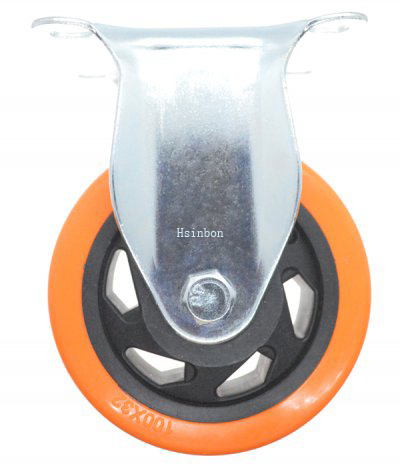
Woodworking shops often have finished floors in certain areas—epoxy coatings in finishing rooms, smooth concrete in assembly areas. A caster that marks or damages these surfaces is unacceptable. Hsinbon uses premium polyurethane treads (typically 90–95 Shore A) that provide excellent floor protection while delivering the necessary traction to move heavy machines without slipping.
For shops with older, uneven floors, Hsinbon offers softer polyurethane formulations (around 75–85 Shore A) that conform slightly to surface irregularities, reducing vibration transmission and improving grip. The polyurethane is chemically bonded to the wheel core—usually cast iron, steel, or aluminum—preventing delamination even under heavy loads or during sharp turns.
Vibration Damping and Machine Accuracy
Precision woodworking depends on stable, vibration-free machinery. A table saw that vibrates during a cut produces rough edges and inaccurate dimensions. While much of this stability comes from the machine’s own construction, casters play a supporting role. Hsinbon incorporates vibration-damping features into its woodworking casters: elastomeric pads between the wheel and yoke, precision-machined bearing seats to minimize runout, and rigid caster configurations that prevent unwanted swiveling during operation.
For machines that require absolute stability during use—such as jointers or thickness planers—Hsinbon recommends a combination of swivel casters with total-lock brakes and rigid casters for straight-line tracking. Once positioned, the total-lock brakes immobilize both wheel rotation and swivel action, effectively transforming the mobile machine into a stationary one. This hybrid approach gives shops the best of both worlds: mobility when needed, rock-solid stability during operation.
Real-World Applications Across Shop Types
Hsinbon casters are deployed across diverse woodworking environments:
Small Cabinet Shops: Portable table saws and miter saw stands use Hsinbon medium-duty casters with quick-release mounting plates, allowing tools to be quickly mobilized for jobsite work or repositioned in the shop.
Furniture Factories: Large sliding table saws and edgebanders roll on Hsinbon heavy-duty casters with leveling feet. These machines can be moved for maintenance access or floor cleaning, then precisely repositioned and leveled within minutes.
Millwork Facilities: Wide-belt sanders and molders—often exceeding 2,000 pounds—rely on Hsinbon extra-heavy-duty casters with dual-wheel configurations, distributing weight across a broader floor area to prevent cracking concrete slabs.
Custom Door and Window Shops: Assembly tables and clamping jigs use Hsinbon casters with non-marking polyurethane wheels, protecting finished floors while allowing easy repositioning of workpieces.
Home Workshops: Hobbyists appreciate Hsinbon compact casters for workbenches and tool stands, appreciating the same professional-grade durability in smaller packages.
Ergonomics and Operator Safety
Moving heavy woodworking machinery is inherently risky. A caster that binds or requires excessive force increases the chance of muscle strains or dropped loads. Hsinbon designs for low rolling resistance: precision ball bearings in wheel hubs, polished swivel raceways, and optimized tread compounds reduce the effort needed to move even 1,000-pound machines.
Safety features include extended brake pedals that are easy to operate even with steel-toed boots, and anti-static wheel options for shops working with explosive dusts (such as those generated when sanding certain exotic hardwoods). For shops with sloped floors, Hsinbon offers directional locks that prevent unintended rolling, keeping machines securely in place between moves.
Customization for Specialized Equipment
Woodworking machinery comes in endless configurations. China Hsinbon Caster Manufacturing Co., Ltd. leverages its vertical integration—in-house stamping, welding, machining, and polyurethane casting—to customize casters for unique applications. Offset adjustments accommodate unusual machine footprints. Extended stem lengths fit through-thickness workbench tops. Specialized wheel diameters navigate low-clearance situations. For OEMs building woodworking machinery, Hsinbon collaborates during the design phase to integrate casters seamlessly into the machine’s frame, ensuring optimal weight distribution and maneuverability.
Maintenance and Longevity
A woodworking caster’s lifespan depends on maintenance, but Hsinbon designs minimize upkeep. Sealed bearings require no lubrication for years of service. Polyurethane treads resist cutting and chunking from sharp debris. Zinc-plated or powder-coated finishes protect against rust in humid environments common near wood glue applicators or finishing booths.
When maintenance is required, Hsinbon’s modular design simplifies repairs. Bearings can be replaced without discarding the entire caster. Wheels can be swapped independently of the yoke. This serviceability extends the equipment’s useful life and reduces long-term costs—a critical consideration for small shops operating on tight margins.
Conclusion: Enabling Workshop Flexibility
In modern woodworking, flexibility equals competitiveness. Shops that can quickly reconfigure their layout to accommodate different projects, streamline workflow, or make room for new equipment gain a decisive advantage. Casters make this agility possible, but only if they’re engineered for the specific demands of woodworking machinery.
China Hsinbon Caster Manufacturing Co., Ltd., through its Hsinbon brand, has spent decades perfecting this specialization. By focusing on load capacity, dust protection, vibration control, and operator safety, they’ve created casters that don’t just move machines—they enhance the entire woodworking process. For cabinetmakers, furniture manufacturers, and custom shops worldwide, that reliability translates directly into better products, safer workplaces, and more efficient operations. In an industry where precision matters, Hsinbon casters deliver the mobility that keeps woodshops moving forward, one smooth roll at a time.