Casters for Painting Booths and Dryers: Heat Resistance, Cleanliness, and Reliability in Finishing Systems
In automotive refinishing centers, industrial coating lines, and large-scale furniture finishing plants, painting booths and drying ovens represent the most controlled environments in the facility. These spaces are designed to maintain dust-free airflow, precise temperature regulation, and strict chemical containment. Within these enclosed ecosystems, the movement of parts—car bodies, metal enclosures, wooden panels, or fabricated components—depends entirely on the performance of the casters attached to carts, dollies, and rack systems. A single caster failure inside a paint booth or dryer can cause irreparable defects: a wheel shedding particles ruins a flawless clearcoat; a seized bearing delays an entire oven cycle; a corroded frame contaminates a clean-air environment. For more than twenty years, China Hsinbon Caster Manufacturing Co., Ltd. has engineered casters specifically for finishing applications, where heat, chemicals, and contamination control converge. Under the brand Hsinbon, the company provides mobility solutions that withstand extreme conditions while preserving the integrity of the coating process.
The Finishing Environment: Hostile to Ordinary Casters
Painting booths and drying ovens create a uniquely demanding set of operating conditions. Booths maintain laminar airflow to carry overspray away from the workpiece, requiring all surfaces—including caster frames—to be smooth, non-shedding, and easy to clean. Overspray from paints, primers, and clearcoats accumulates on every exposed surface, gradually building up on wheel treads and caster forks. If a caster sheds flakes of dried paint or rust, those particles become defects in the next batch of finished parts.
Dryers and curing ovens introduce intense heat. Conventional industrial casters fail rapidly in these environments: standard polyurethane softens and deforms above 80°C; nylon melts near 180°C; zinc-plated finishes blister and peel; grease liquefies and leaks onto the floor. Hsinbon addresses these challenges with materials and designs validated for sustained high-temperature operation. Their high-temp caster series uses specially formulated polyurethane, phenolic, or high-performance thermoplastic wheels rated for continuous use at 150°C, 200°C, or even 300°C, depending on the application.
Chemical exposure adds another layer of complexity. Solvents such as acetone, MEK, and xylene are used for surface preparation and cleanup. Acid-based etchants, alkaline cleaners, and various paint thinners contact caster surfaces regularly. Hsinbon specifies chemically resistant polymers and stainless-steel alloys that resist degradation, swelling, or embrittlement when exposed to these substances.
High-Temperature Performance in Drying Ovens
The most critical performance requirement for drying oven casters is dimensional stability at elevated temperatures. As a cart loaded with freshly painted parts enters a 150°C curing oven, the casters must support the load without softening, deforming, or releasing volatile compounds that could condense on the parts. Hsinbon high-temp casters employ several strategies to meet this challenge:
Wheel Materials: For moderate-temperature applications (up to 150°C), Hsinbon uses high-temperature polyurethane formulated with heat-stable polyols and isocyanates. These wheels retain their load-bearing capacity and rebound characteristics throughout the curing cycle. For higher temperatures (200–300°C), phenolic resin wheels or high-performance thermoplastics such as PEEK (polyetheretherketone) are specified, offering exceptional thermal stability and low outgassing.
Bearing Selection: Standard lubricated ball bearings fail in ovens as grease breaks down and evaporates. Hsinbon high-temp casters use either dry-lubricated bearings (graphite-filled bronze or self-lubricating polymers) or high-temperature grease rated for continuous operation at the target temperature. In extreme cases, the company designs casters with ceramic ball bearings that require no lubrication and withstand temperatures exceeding 400°C.
Frame Construction: Steel caster frames are stress-relieved after welding to prevent warping under thermal cycling. For the most aggressive oven environments, Hsinbon fabricates frames from heat-resistant stainless steels (such as 310S or Inconel alloys) that maintain strength and oxidation resistance at sustained high temperatures.
Cleanliness and Particle Control in Paint Booths
Paint booths demand the opposite of oven casters: cool operation, ultra-clean surfaces, and zero particulate generation. Hsinbon cleanroom-grade casters for painting applications feature smooth, crevice-free geometries that prevent overspray accumulation. Frames are fabricated from 304 or 316 stainless steel with welded or radiused corners—no threads, bolts, or recesses where paint can build up and later flake off.
Wheel treads are formulated from non-marking, non-shedding polyurethane or conductive polymers that prevent static attraction of dust particles. Conductive casters are particularly important in automotive paint booths, where static discharge can attract airborne contaminants or even create spark hazards in solvent-rich environments. Hsinbon ESD-capable casters provide controlled electrical dissipation (10⁶–10⁹ Ω surface resistivity) while maintaining the same cleanability and chemical resistance required for finishing applications.
Bearing seals are critical in paint booths. Hsinbon uses triple-lip polymer seals or metal shielding to prevent overspray from entering the bearing raceway. The seals are designed for easy cleaning—smooth external surfaces that wipe clean with solvent, preventing dried paint from accumulating and eventually breaking off as particulate.
Corrosion Resistance in Wet Finishing Processes
Many finishing systems include pretreatment stages: phosphate coating, e-coat dipping, anodizing, or electroplating. These processes expose casters to corrosive chemicals, high humidity, and frequent washdowns. Hsinbon corrosion-resistant casters for these applications use 316L stainless steel frames, chemically inert polymer wheels (such as PVDF or PTFE), and sealed stainless bearings. Even the mounting hardware—bolts, nuts, and washers—is specified in matching corrosion-resistant alloys to prevent galvanic corrosion at connection points.
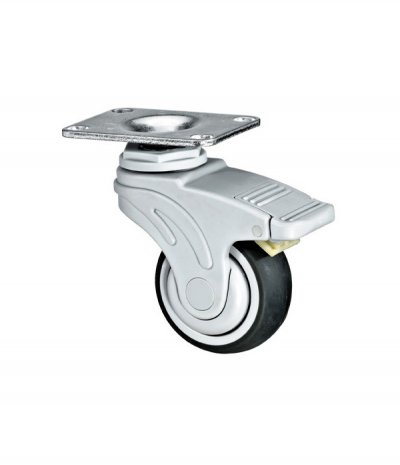
For facilities that use steam cleaning or high-pressure washdowns with caustic detergents, Hsinbon offers casters with additional protective measures: welded frame construction (eliminating bolted joints that trap cleaning solution), drain holes in wheel hubs to prevent water accumulation, and specialized coatings that resist chemical attack.
Load Distribution and Cart Stability
Painting and drying carts often carry heavy, awkwardly shaped loads. An automotive body cart may support a 400 kg vehicle shell; a furniture finishing rack holds dozens of chair frames totaling 600 kg. Hsinbon engineers these applications with careful attention to load distribution. Heavy-duty series use double-ball swivel raceways, reinforced yokes, and thick-section wheel cores to distribute weight evenly. For extremely heavy loads, dual-wheel casters spread the burden across two parallel wheels, reducing floor pressure and improving stability.
Braking systems are tailored to finishing workflows. Total-lock brakes secure carts during painting and curing, preventing movement that could disturb freshly applied coatings. Directional locks help operators guide long, narrow carts through booth doors and along predefined pathways. All brake mechanisms are designed for operation with gloved hands and are accessible from multiple angles to accommodate different cart orientations.
Real-World Applications Across Industries
Hsinbon casters are deployed in diverse finishing environments:
Automotive Refinishing: Car body dollies in prep stations use stainless cleanroom casters with conductive wheels, preventing static buildup while supporting 500+ kg loads through multiple paint layers and flash-off periods.
Industrial Powder Coating: Rack systems in powder coat lines roll on high-temp phenolic-wheel casters, surviving 200°C curing cycles without deformation or outgassing that could contaminate the powder finish.
Wood Furniture Finishing: Spray booth carts carrying chair frames and table tops use Hsinbon polyurethane-tread casters that won’t mark finished floors and resist buildup of lacquer overspray.
Aerospace Component Coating: Landing gear parts and engine components move through multi-stage coating processes on Hsinbon corrosion-resistant casters, withstanding chromic acid anodizing baths and high-temperature primer curing.
Electronics Manufacturing: Circuit board racks in conformal coating booths use ESD-safe casters to prevent static discharge while navigating cleanroom environments.
Maintenance and Cleaning Protocols
Finishing facilities operate on tight schedules—a delayed cart can bottleneck an entire production line. Hsinbon designs casters for easy maintenance in these environments. Wheel assemblies are removable without special tools, allowing quick replacement when treads become contaminated with cured paint. Bearing seals are accessible for cleaning or replacement. Frame surfaces are smooth and chemical-resistant, simplifying daily wipe-downs with solvent.
For facilities implementing predictive maintenance programs, Hsinbon can supply casters with embedded RFID tags or QR codes that store maintenance history, load ratings, and replacement part numbers. This digital integration helps maintenance teams track caster condition and schedule replacements before failures occur.
Customization for Specialized Finishing Systems
No two finishing lines are identical. China Hsinbon Caster Manufacturing Co., Ltd. leverages its vertical integration to customize casters for unique requirements. Offset dimensions are adjusted to match specific cart geometries. Wheel diameters are optimized for floor conditions and door clearances. Mounting patterns are tailored to existing equipment. For OEMs building painting booths and drying ovens, Hsinbon engineers collaborate during the design phase to integrate casters seamlessly into the overall system architecture.
Specialized requirements receive particular attention. Casters for cleanroom paint booths undergo additional surface treatments to reduce particle generation. High-temp casters for infrared curing ovens are tested for outgassing characteristics. Corrosion-resistant casters for marine coating facilities are validated against salt spray and seawater exposure.
Sustainability and Regulatory Compliance
Modern finishing facilities face increasing pressure to reduce environmental impact. Hsinbon supports these goals with sustainable caster designs: recyclable stainless steel frames, polyurethane wheels formulated without hazardous plasticizers, and modular construction that enables component replacement rather than complete caster disposal. The company maintains comprehensive material declarations to support customers’ chemical compliance programs, including RoHS, REACH, and conflict-minerals reporting.
Conclusion: Precision Mobility in the Most Demanding Environments
Painting booths and drying ovens represent the intersection of multiple extreme conditions: heat, chemicals, cleanliness requirements, and heavy loads. Standard industrial casters simply cannot survive in these environments, let alone perform reliably. China Hsinbon Caster Manufacturing Co., Ltd., through its Hsinbon brand, has developed specialized expertise in this niche, engineering casters that meet the precise requirements of finishing applications.
From automotive assembly plants to aerospace coating facilities, from furniture factories to electronics manufacturers, Hsinbon casters enable the smooth, reliable movement of parts through critical finishing processes. By addressing heat resistance, chemical compatibility, contamination control, and load management in a single integrated design, these casters help ensure that the final product meets the highest quality standards—flawless finishes, consistent curing, and zero defects attributable to mobility equipment. In the world of industrial finishing, where perfection is the baseline expectation, Hsinbon delivers the reliable foundation that makes that perfection possible.