Casters for Electronic Testing Racks: Static Control and Stability for Sensitive Instrumentation
In electronics R&D labs, PCBA validation rooms, and end-of-line test stations, the most valuable assets are invisible—microchips, unpopulated boards, calibrated sensors, and proprietary firmware sitting inside rack-mounted equipment. A single electrostatic discharge event, a jolt from a poorly damped wheel, or a conductive pathway broken by an oxidized caster yoke can destroy a prototype worth tens of thousands of dollars or corrupt a full test run. Electronic testing racks—housing oscilloscopes, spectrum analyzers, power supplies, burn-in boards, and server blades—must be mobilized for reconfiguration, maintenance access, or relocation between test cells. Those racks depend on casters that do far more than roll. They must dissipate static charge in a controlled manner, protect sensitive flooring, lock immovably during data acquisition, and endure years of lab-grade cleaning. For more than twenty years, China Hsinbon Caster Manufacturing Co., Ltd. has specialized in engineering casters for electrostatic-protected areas and precision equipment environments. Under the brand Hsinbon, the company provides ESD-safe, low-vibration mobility solutions purpose-built for electronic testing racks, debug carts, and instrumentation trolleys used in labs and production test floors worldwide.
The Hidden Risks of Moving Sensitive Electronics
An electronic test rack is typically a 19-inch enclosure standing 1.2 to 2.2 meters tall, loaded with modular instruments and sometimes a built-in UPS battery backup. Weights range from 80 kg for a basic bench-top rack on wheels to over 500 kg for a fully loaded server or burn-in test chassis. Moving such a rack through a lab aisle generates two simultaneous risks.
First is electrostatic charge accumulation. Rolling friction between wheel and floor can generate and separate charge. If the wheel, axle, fork, and mounting plate are not in continuous electrical continuity—and if the wheel compound is not formulated to dissipate charge—the rack becomes an isolated conductor that can discharge into a grounded technician or, worse, back-feed through connected test leads into a board under test. The damage is often latent: a weakened gate oxide, a shifted bias point, an intermittent failure that only appears after the product ships.
Second is mechanical shock and vibration. Test equipment—especially high-resolution ADCs, atomic clocks, and laser interferometers—has specified vibration limits. A caster that transmits every floor joint or threshold bump directly to the rack can induce measurement error or, in extreme cases, dislodge card cages. Hsinbon addresses both risks with its ESD caster platform: controlled static dissipation through the wheel-to-frame-to-floor path, plus precision bearings and optional elastomeric damping to isolate the load.
Static Dissipation: How Hsinbon ESD Casters Work
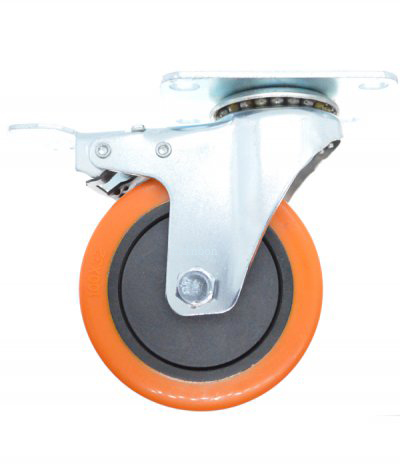
An ESD caster is not merely a wheel made of conductive rubber. It is a complete grounding system. Hsinbon ESD-series casters for electronic test racks are engineered with a continuous low-resistance path: the tread compound contacts the ESD-compliant floor; the wheel core is carbon-black-impregnated polymer or conductive nylon bonded to a metal insert; the axle makes direct metal-to-metal contact with the yoke (no insulating paint or zinc barrier in the current path); and the yoke is in firm contact with the mounting plate, which bolts to the rack's conductive frame. The rack frame, in turn, connects to earth ground through its own grounding scheme.
The wheel tread is formulated from static-dissipative polyurethane (typically 10⁶–10⁹ Ω surface resistivity) or conductive thermoplastic rubber (10⁴–10⁶ Ω), selected according to the facility's ESD control program. Dissipative compounds are preferred for general electronics labs because they bleed off charge slowly enough to prevent a rapid arc while still keeping the rack potential within safe limits relative to grounded objects. Conductive formulations are chosen for environments with intrinsically safe requirements or where very fast equalization is mandated.
All Hsinbon ESD casters are assembled so that no non-conductive coating interrupts the grounding path. Fasteners are zinc-nickel plated or passivated stainless steel. Where requested, the company supplies an auxiliary grounding stud on the caster top plate for a supplemental grounding strap—adding redundancy for mission-critical test setups.
Non-Marking, Low-Particulate Treads for Lab Flooring
Electronic labs and test floors are commonly finished with seamless epoxy, vinyl composition tile (VCT), or raised-access flooring with conductive tiles. These surfaces must not be scuffed. Hsinbon specifies non-marking tread compounds—gray or light-blue static-dissipative polyurethane—that leave no carbon transfer on the floor even after prolonged static loading. The compound is also formulated for low particulate generation: it does not abrade or flake under normal rolling, so it will not shed debris into a clean-ish lab environment where even moderate dust could affect optical or MEMS testing.
Wheel cores are precision-machined aluminum or glass-filled nylon, chemically keyed to the tread material to prevent delamination. Hub bearings are sealed precision ball or sintered bronze (for dry operation in ESD zones where grease outgassing is undesirable), with shields that keep dust out and contained lubricant in.
Stability, Braking, and Vibration Control
Test racks must stay put during operation. A drifting oscilloscope cart can tug on fragile probe leads; a rolling server rack can strain power or data cables. Hsinbon fits its ESD test-rack casters with total-lock brakes that simultaneously clamp the wheel tread and lock the swivel raceway via a single foot-pedal actuation. This dual immobilization prevents both translation and rotation—critical when a rack is positioned next to a test bench with cables connected.
For taller racks, Hsinbon recommends a two-swivel / two-rigid configuration: the rigid pair provides straight-line tracking when towing the rack; the swivel pair (with directional locks) allows tight-radius turns during placement. All brake pedals are sized for operation with safety shoes and are accessible from both caster faces, with smooth contours that wipe clean of spilled isopropanol or flux remover.
Vibration control is addressed through bearing preload and, where specified, spring-loaded or elastomer-damped yokes. For racks carrying vibration-sensitive instruments (e.g., atomic force microscopes, precision time-base references), Hsinbon shock-absorbing ESD casters use a nested spring and elastomeric snubber to filter floor irregularities below approximately 5 Hz—reducing peak acceleration transmitted to the chassis.
Load Rating and Rack Footprint Considerations
A standard 42U server or test rack on four casters requires careful load calculation. Hsinbon advises a safety factor of at least 3:1 for static loads and 1.5:1 for dynamic (moving) loads. A 400 kg loaded rack would therefore need casters rated at minimum 133 kg each for static stability, typically rounded up to the next standard size—commonly 5-inch (125 mm) or 6-inch (150 mm) diameter wheels with dynamic load ratings of 150–200 kg per caster depending on fork thickness and bearing type.
Overall height and offset are matched to the rack base. Hsinbon supplies both standard square top plates (e.g., 70×58 mm, 100×80 mm) and threaded stems (M12, M16, ½″-13UNC) to fit common rack caster mounting patterns. For OEMs building test enclosures, the engineering team at China Hsinbon Caster Manufacturing Co., Ltd. collaborates on offset and swivel radius optimization so that the rack's center of gravity remains within the caster polygon throughout the tilt envelope.
Real-World Deployments: From Burn-In Lines to Field Service Carts
Hsinbon ESD casters are found in a variety of electronic test environments:
PCB Burn-In & Functional Test Lines: Racks holding multiple DUT (device-under-test) interface boards roll on Hsinbon dissipative-PU casters with total-lock brakes. The racks are moved between climate-controlled chambers and programming stations without disconnecting the frame ground.
Oscilloscope & Logic Analyzer Carts: Mobile instrument clusters in R&D labs use Hsinbon 4-inch ESD swivel casters with blue dissipative tread for visual identification. The small overall height preserves under-bench clearance while the sealed bearings resist ingress of solder-flux aerosol.
Server & Network Test Bays: Data center staging areas equip rolling server racks with Hsinbon conductive-nylon-wheel ESD casters, rated for heavier loads and compatible with raised-access conductive flooring.
Field Service & Calibration Trolleys: Portable calibration standards and reference meters travel on shock-absorbing ESD casters that protect delicate references from vehicle-transit vibration before reaching the customer site.
One lab manager at a semiconductor test house noted: "We retrofitted our debug carts with Hsinbon ESD casters after seeing intermittent ESD damage traced to charge buildup on the old plastic-wheel carts. The difference was immediate—no more mystery failures after moving a board between the handler and the curve tracer."
Chemical Resistance and Lab Cleanability
Test areas use isopropyl alcohol, acetone, flux removers, and mild detergents for daily wipe-downs. Hsinbon ESD wheel compounds are validated for resistance to these agents—no swelling, softening, or surface crazing after repeated exposure. Frame finishes are available in polished 304 stainless steel (for clean-adjacent labs) or zinc-nickel plating (for general ESD labs). Both resist corrosion from periodic cleaning and from the mildly acidic atmosphere near soldering stations.
The caster exterior is deliberately smooth—no decorative caps, undercuts, or exposed threads where flux residue or dust can accumulate. This facilitates quick cleaning with lint-free wipes and IPA, supporting the lab's housekeeping and ESD audit protocols.
Customization and Documentation for ESD Programs
Customers implementing formal ESD control per ANSI/ESD S20.20 or IEC 61340 typically require material declarations and resistance verification data. China Hsinbon Caster Manufacturing Co., Ltd. provides batch-level documentation: wheel compound resistivity range, point-to-point resistance through the assembled caster, and metallurgical certificates for stainless components. Custom colors—most commonly blue for ESD identification—are available for treads or fork powder-coating to align with the facility's visual-management system.
For OEM test-equipment builders, Hsinbon can pre-assemble casters with specified hardware (nyloc nuts, lock washers, internal-tooth star washers) and apply thread-locking compound to the correct torque, reducing field-installation variability.
Lifecycle Value in the Research Environment
Electronic test racks are long-lived assets—often remaining in service 10–15 years. Hsinbon caster construction supports that lifecycle. Sealed bearings are lubricated for life; polyurethane treads resist chunking and flat-spotting even when a rack sits parked for weeks. When a wheel eventually wears, the modular design permits tread-and-hub replacement without discarding the fork, preserving the original ESD-path hardware and reducing waste. Spare-part compatibility is maintained across production batches, a practical advantage for facilities managing dozens of racks procured in phases.
Conclusion: Protecting What You're Trying to Test
In electronics testing, the objective is to reveal the truth about a device's performance—not to introduce new variables. An ill-suited caster introduces two: uncontrolled static and mechanical disturbance. China Hsinbon Caster Manufacturing Co., Ltd., through its Hsinbon brand of ESD casters for electronic testing racks, removes those variables by design. With continuous grounding paths, non-marking dissipative treads, secure total-lock braking, and vibration-aware engineering, these casters let technicians reposition test equipment confidently—knowing the only thing that changed is the rack's location, not the integrity of what's inside it.
From prototype validation benches to high-volume burn-in lines, from university photonics labs to tier-one semiconductor fabs, Hsinbon casters roll quietly beneath the work that powers the digital world—protecting sensitive electronics one grounded path at a time.