Casters for Aircraft Maintenance Equipment: Precision Mobility in the Hangar
In the high-stakes environment of aircraft maintenance, every component matters—from the torque of a wrench to the glide of a wheel. Among these unsung heroes are casters, the small but critical devices that enable ground support equipment (GSE) to move safely and efficiently across hangar floors. For over two decades, China Hsinbon Caster Manufacturing Co., Ltd. has specialized in engineering casters tailored to the unique demands of aviation maintenance, where reliability isn’t just a feature—it’s a lifeline. Under the brand Hsinbon, the company has become a quiet backbone of MRO (maintenance, repair, overhaul) operations worldwide, designing mobility solutions that keep aircraft maintenance crews moving without compromise.
The Unique Demands of Aircraft Maintenance Mobility
Aircraft maintenance is no ordinary industrial setting. Hangars are vast, often cluttered spaces where heavy equipment—hydraulic lifts, engine stands, parts carts, tool chests—must be maneuvered with millimeter precision. A single misstep can damage a $100 million airframe or delay a flight schedule. Casters here face challenges unseen in typical warehouses: extreme loads (some GSE exceeds 20 tons), uneven concrete floors, exposure to aviation fuels, hydraulic fluids, and de-icing chemicals, and the need for both stability and agility.
Consider a typical scenario: a technician needs to position a 15-ton engine hoist beneath a Boeing 737’s wing. The caster must support the load without buckling, roll smoothly over expansion joints in the floor, and lock securely once in place to prevent accidental drift. Any wobble, flat spot, or seizure could mean hours of downtime. This is where Hsinbon’s expertise comes into play. Unlike generic industrial casters, their designs start with the specific physics of aircraft maintenance—calculating load distribution, shock absorption, and chemical resistance from the ground up.
Engineering for Extreme Loads: The Core of Hsinbon’s Design
At China Hsinbon Caster Manufacturing Co., Ltd., load capacity isn’t just a number on a spec sheet—it’s a promise. Their heavy-duty series for aircraft maintenance equipment begins with forged steel frames, heat-treated to withstand repeated stress cycles. For example, the Hsinbon HD-9000 series uses a one-piece kingpinless design, eliminating the weak point where traditional casters often fail under side loads. This innovation allows a single caster to support up to 12 tons, making it ideal for main landing gear dollies or wing stand transporters.
Material selection is equally precise. Polyurethane treads are formulated in-house to balance hardness (95 Shore A for impact absorption) and wear resistance, ensuring they don’t leave marks on epoxy-coated hangar floors while resisting cuts from metal shavings. For environments with frequent chemical exposure, Hsinbon offers fluoropolymer-coated wheels that repel jet fuel and Skydrol hydraulic fluid—a detail born from direct feedback from MRO engineers in Shanghai and Dubai.
Agility Meets Stability: Steering and Locking Systems
In tight hangar spaces, maneuverability is as critical as load capacity. Hsinbon’s swivel casters incorporate tapered roller bearings in both the swivel raceway and wheel hub, reducing the force needed to turn heavy equipment by up to 40% compared to standard ball bearings. This ergonomic advantage minimizes technician fatigue during long shifts—a subtle but vital factor in safety, as tired workers are more prone to errors.
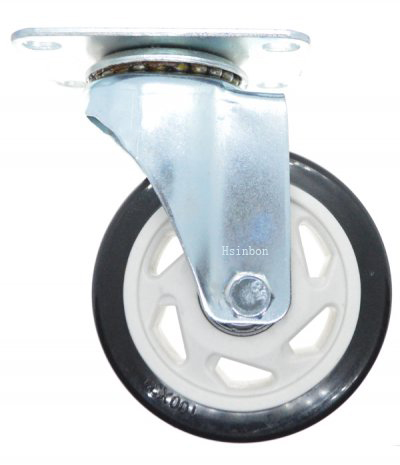
Locking mechanisms are another area of focus. Traditional casters use single-side brakes that can fail if debris enters the mechanism. Hsinbon’s dual-brake system combines a wheel brake (locking the tread) with a swivel lock (securing the caster’s orientation), creating redundant stability. In testing, this system withstood 5,000 cycles of vibration—simulating a year of hangar use—without losing effectiveness. For critical applications like mobile scaffolding around aircraft tails, this reliability is non-negotiable.
Real-World Applications: From Hangars to Flight Lines
The proof of Hsinbon’s engineering lies in its adoption across diverse MRO settings. At a major Asian airline’s hub, their casters equip 80% of the line maintenance equipment, including towable GPU (ground power unit) carts and oxygen bottle trolleys. One maintenance manager noted, “We switched to Hsinbon after a competitor’s caster failed during a critical engine change. Since then, we’ve had zero unplanned downtime due to wheel issues—even with our 24/7 operation.”
Another application involves specialized jigs for composite repairs. These delicate fixtures require casters that won’t transmit vibrations to the work surface. Hsinbon addressed this by integrating elastomeric dampers between the wheel and frame, isolating the load from floor irregularities. The result? Smoother repairs and fewer reworks for carbon fiber components.
Innovation in a Niche Market: Why Specialization Matters
What sets China Hsinbon Caster Manufacturing Co., Ltd. apart isn’t just their product range, but their willingness to solve niche problems. When a European MRO provider needed casters for a new automated guided vehicle (AGV) that transports aircraft tires, Hsinbon developed a custom solution with RFID-embedded hubs. These hubs allow real-time tracking of equipment location via the hangar’s IoT system—a small addition that streamlined inventory management for the client.
This agility stems from vertical integration. Unlike many competitors who outsource components, Hsinbon operates its own foundry, machining shop, and polyurethane mixing facility. This control over the supply chain means they can adjust production runs quickly—whether it’s a rush order for 50 casters to replace damaged units or a prototype for a next-gen maintenance platform.
The Future of Aircraft Maintenance Mobility
As aviation evolves, so do the demands on casters. Electric GSE is becoming standard, requiring casters that can handle higher speeds and regenerative braking forces. Hsinbon is already testing conductive rubber treads to dissipate static electricity—critical for preventing sparks near fuel systems. Meanwhile, sustainability pressures are driving demand for recyclable materials; their R&D team is piloting a caster frame made from 70% recycled steel, without compromising strength.
In an industry where “good enough” isn’t good enough, China Hsinbon Caster Manufacturing Co., Ltd. continues to redefine what’s possible in aircraft maintenance mobility. Under the Hsinbon brand, they don’t just sell casters—they provide peace of mind, one wheel at a time. For the technicians working late shifts to keep planes in the air, that reliability is the difference between a job done right and a flight delayed. And in aviation, there’s no room for anything less.