Different Types of Caster Wheels You Should Know
Not all caster wheels are created equal. Choosing the wrong type can lead to premature wear, floor damage, excessive push force, or even equipment failure. Casters are typically categorized by duty rating, wheel material, mounting style, and special function. Knowing these classifications helps you match the right caster to your specific application.
1. By Duty Rating
Light Duty Casters – Designed for loads up to approximately 100 kg (220 lbs) per caster. Commonly used on office chairs, display stands, small carts, and household furniture. Usually smaller in diameter with thinner bracket stampings.
Medium Duty Casters – Suitable for loads roughly between 100–450 kg (220–1,000 lbs) per caster. Found on hospital beds, food-service trolleys, and medium industrial carts. Offer thicker steel forks and larger wheel diameters for improved rolling ease.
Heavy Duty Casters – Built for loads exceeding 450 kg per caster, with reinforced forged or welded brackets, double-ball swivel raceways, and precision bearings. Ideal for heavy machinery, die carts, and bulk-material handling in factories and warehouses.
2. By Wheel Material
The tread material determines how the caster interacts with the floor and the environment:
Wheel Material | Key Characteristics | Typical Applications |
|---|---|---|
Polyurethane (PU) | High load capacity, non-marking, oil & abrasion resistant, floor-friendly | Warehouses, factories, logistics carts |
Rubber / TPR | Quiet rolling, shock absorbing, good grip, protects delicate floors | Hospitals, offices, laboratories, retail |
Nylon / Glass-Filled Nylon | Very low rolling resistance, corrosion & chemical resistant, durable | Food processing, cold storage, chemical plants |
Phenolic Resin | Hard, heat-resistant, withstands high static loads, resists oil & grease | Bakeries, kilns, dry warehouse floors |
Cast Iron / Steel | Extreme load capacity, heat-tolerant, very hard tread | Foundries, steel mills, heavy fabrication (requires hard floor) |
Pneumatic / Flat-Free | Air-filled or foam-filled for shock absorption over bumps & gravel | Outdoor carts, landscaping, uneven terrain |
3. By Mounting Style
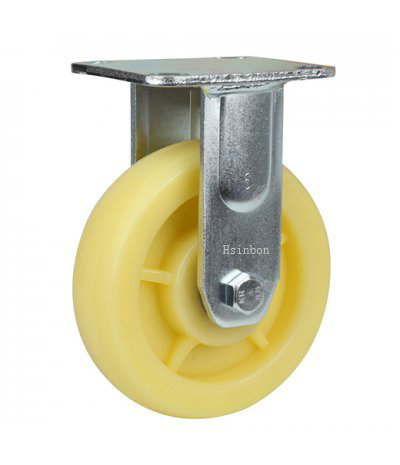
Top Plate Mount – A flat steel plate with bolt holes, bolted to the equipment. Provides maximum stability and is the standard for medium- and heavy-duty industrial use.
Stem Mount – A single stem (threaded, grip-ring, or expanding) inserts into a socket. Common on furniture, medical equipment, and light-duty trolleys where quick installation matters.
Bolt-Hole Mount – A single centered hole for a bolt or pin; compact and often used on European-style institutional carts and display units.
4. By Function & Special Features
Swivel Casters – 360° rotation for maximum maneuverability in tight spaces.
Rigid (Fixed) Casters – Roll only in a straight line, providing directional stability; typically paired with swivel casters.
Braked / Locking Casters – Include wheel brakes (stops rolling) or total-lock brakes (stops both rolling and swiveling) for safety on slopes or stationary workstations.
Shock-Absorbing Casters – Spring- or elastomer-mounted to dampen vibration and protect sensitive cargo.
Leveling Casters – Feature a retractable leveling foot to raise equipment off the wheels for precise positioning on uneven floors.
Stainless Steel / Washdown Casters – Corrosion-resistant construction for food, pharmaceutical, and marine environments.
Selecting the correct combination of duty class, wheel material, mounting type, and functional features ensures longer service life, safer operation, and lower maintenance costs. China Hsinbon Caster Manufacturing Co., Ltd. supplies a full range of light-, medium-, and heavy-duty caster wheels—available in polyurethane, rubber, nylon, phenolic, and steel—with plate or stem mounts and optional braking or shock-absorbing features, engineered for reliable performance across industrial, commercial, and institutional settings.
If you'd like, I can now write the final piece in your series — "How to Calculate Load Capacity & Choose the Right Caster Size for Your Equipment".