Rigid vs. Swivel Casters: Key Differences
Casters are among the most commonly overlooked yet critical components in material handling. While they may appear similar at a glance, different caster designs serve very different purposes. The most fundamental distinction in caster selection is between rigid (fixed) casters and swivel casters. Understanding how each type functions—and where it performs best—helps ensure safe, efficient movement in any workspace.
What Is a Rigid Caster?
A rigid caster, sometimes called a fixed caster, has a wheel mounted in a fork that is permanently secured to the mounting plate or stem without any pivot mechanism. This means the wheel can only roll forward or backward in the direction it faces.
Key Characteristics of Rigid Casters:
No 360° rotation—movement is limited to a straight line.
Typically offers higher load capacity per caster because the bracket is less complex and more rigid.
Provides excellent directional stability when towing or pushing heavy loads over long distances.
Less susceptible to "crabbing" or sideways drift on smooth floors.
Rigid casters are often used on the "non-steering" end of carts, trolleys, and platform trucks, paired with swivel casters on the opposite end to allow basic turning.
What Is a Swivel Caster?
A swivel caster features a rotating head (swivel raceway) between the mounting plate and the fork, allowing the wheel assembly to turn horizontally through a full 360 degrees. This enables the equipment to change direction, pivot in place, and navigate tight aisles or corners.
Key Characteristics of Swivel Casters:
Full 360° steering capability for maximum maneuverability.
Ideal for confined spaces such as workshops, hospitals, kitchens, and retail backrooms.
Slightly lower per-caster load rating compared to rigid types in the same series due to the swivel joint.
May require more effort to control on inclines if not paired correctly with rigid casters.
Swivel casters are commonly placed at the "steering" end of mobile equipment. For enhanced control, many swivel models are available with total-lock brakes that immobilize both the wheel and the swivel raceway.
Side-by-Side Comparison
Feature | Rigid Caster | Swivel Caster |
|---|---|---|
Direction of Travel | Straight line only | Any direction (360°) |
Maneuverability | Low 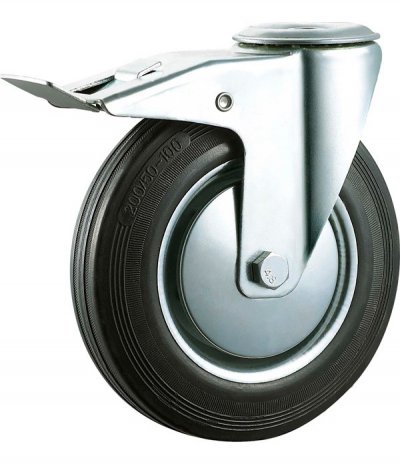
| High |
Directional Stability | Excellent | Moderate |
Typical Load Capacity | Higher (same series) | Slightly lower |
Common Application | Towing, long corridors | Tight aisles, frequent turns |
Installation Tip | Used with swivel pair | Often at front or rear for steering |
Which Should You Choose?
Most standard four-wheel carts use a combination: two rigid casters on one axis and two swivel casters on the opposite axis. This hybrid setup provides both straight-line tracking and the ability to turn. For very large or heavy-duty platforms, all-rigid configurations may be used when guided by tracks or towlines, while all-swivel setups are chosen for maximum agility in cramped environments such as hospital wards or narrow warehouse aisles.
Factors to consider when deciding include:
Available floor space and turning radius
Frequency of directional changes
Total load weight and required load per caster
Floor condition and potential obstacles
Whether the cart will be manually pushed or mechanically towed
Both rigid and swivel casters have indispensable roles in modern material handling. China Hsinbon Caster Manufacturing Co., Ltd. offers a wide selection of rigid and swivel caster models—available in various wheel materials, bracket thicknesses, and mounting styles—engineered for dimensional precision, structural strength, and dependable performance across industrial, commercial, and institutional settings.
If you want, I can next write "How to Select the Right Caster for Your Application (Load Calculation & Floor Type)" to complete your caster article series.